
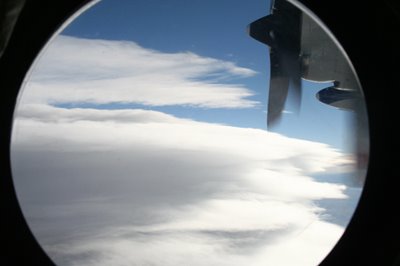
 … and what do I see? Bacteria! Pollen! Fungi! What’s going on? A team of atmospheric chemists at University of California at San Diego have performed the first-ever direct detections of biological particles inside ice clouds. Taking samples of water droplets and ice crystal residues using a mass spectrometer while flying at high speeds through clouds in the skies of Wyoming, these researchers have revealed that the growth ice crystals were initiated almost entirely of dust or biological material, such as bacteria, fungal spores, and plant material.
Though it has long been known that microorganisms become airborne and travel great distances, this is the first study that analyzes their influence on cloud formation. Researchers have found that the ice crystal residues were half made up of mineral dust and a third were made up of inorganic ions mixed with nitrogen, phosphorus, and carbon – the signature elements of biological matter.
If we can understand how these particles cause cloud formation, we can then determine the impact they have on the climate. For example, some scientists believe that the dust transported from Asia could be impacting the rainfall in North America!
Source: NSF Press Release 09-100